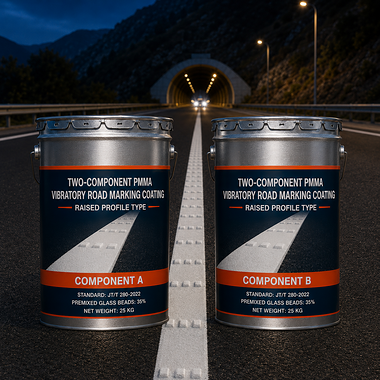
Products Description
TWO-COMPONENT PMMA VIBRATORY ROAD MARKING COATING
Raised-Profile Road Marking for Tactile, Audible and Reflective Traffic Warning
📖 PRODUCT OVERVIEW
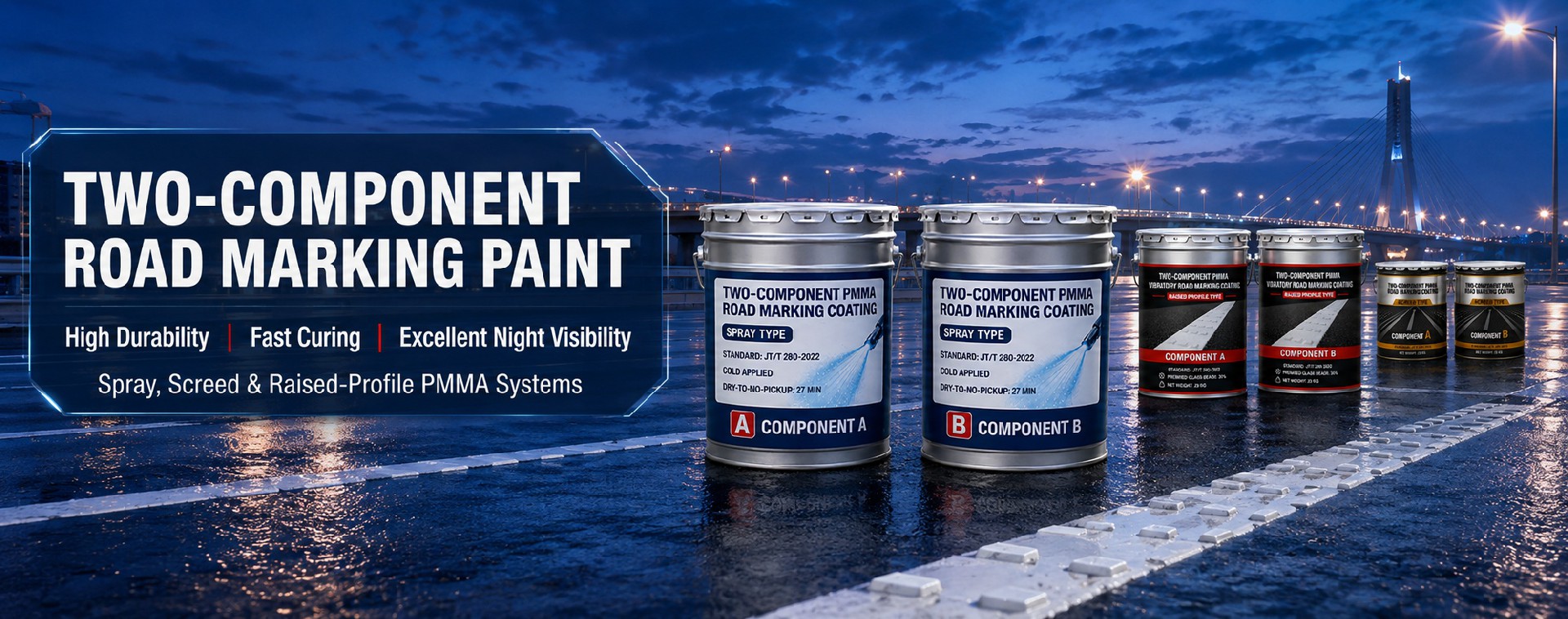
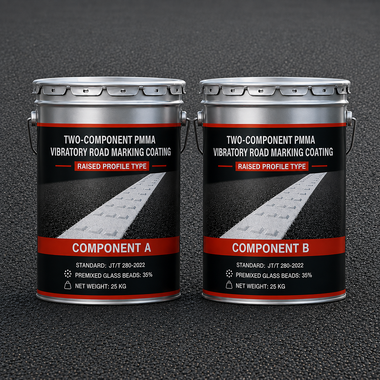
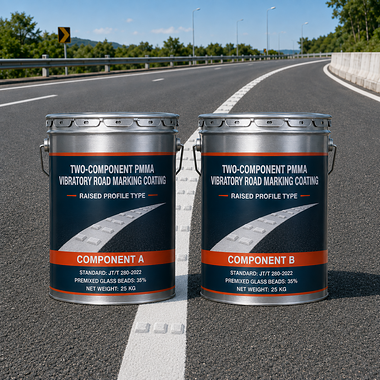
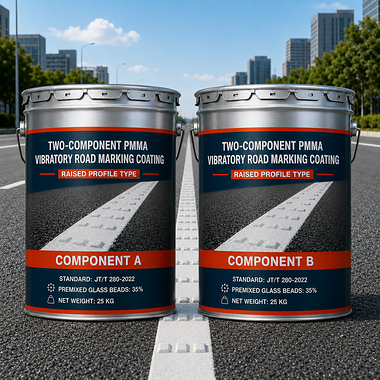
Two-component PMMA vibratory road marking coating is a cold-applied traffic safety material designed to form a continuous longitudinal marking line with regularly spaced raised profiles.
The finished marking consists of a continuous white or yellow base line with small transverse raised blocks positioned at uniform intervals. When vehicle tires pass over these profiles, the marking produces noticeable vibration and tire noise, warning drivers of lane departure, road boundaries, curves, tunnel entrances and other potentially hazardous road sections.
The coating is supplied as matched Component A and Component B materials. After accurate mixing, the components undergo a chemical crosslinking reaction to form a dense and durable marking structure.
The tested white sample was evaluated according to JT/T 280-2022. It contains 35.0% premixed glass beads, with a tested non-volatile content of 88% and VOC content of 5 g/kg.
🔊 TACTILE AND AUDIBLE WARNING
The regularly spaced raised profiles provide two types of physical warning when vehicle tires contact the marking.
Tactile Warning
The raised blocks create noticeable vehicle vibration, reminding drivers that the vehicle is approaching or crossing a designated boundary.
Audible Warning
Tire contact with the raised structure generates an audible warning sound, helping attract the driver’s attention.
This passive warning system requires no electricity, sensors or electronic maintenance.
Actual vibration and sound intensity depend on profile dimensions, spacing, vehicle speed, tire type and pavement conditions.
🛣️ CORRECT RAISED-PROFILE STRUCTURE
The marking is designed as a continuous longitudinal base line with repeated raised blocks formed within the width of the line.
Typical structure:
Continuous white or yellow base marking
Small transverse raised blocks
Uniform spacing between profiles
Raised sections contained within the base line
Premixed and optional drop-on glass bead system
A typical project may specify:
Base layer thickness: approximately 2 mm
Raised profile height: up to approximately 5 mm
Profile height, width and spacing can be adjusted according to engineering drawings, road speed, warning requirements and local specifications.
🧪 TWO-COMPONENT CHEMICAL CURING
The product is supplied as Component A and Component B.
After the components are mixed according to the batch-specific Technical Data Sheet, a chemical curing reaction forms a dense PMMA-based marking layer.
Key benefits include:
✓ Strong coating structure
✓ Firm adhesion to prepared pavement
✓ Good resistance to traffic abrasion
✓ Stable raised-profile formation
✓ Reduced film shrinkage
✓ Good outdoor weather resistance
✓ Suitable for thick and shaped markings
The mixing ratio must follow the product label and Technical Data Sheet supplied with each batch. Do not estimate or change the ratio at the construction site.
✨ 35% PREMIXED GLASS BEADS
The tested white coating contains 35.0% premixed glass beads.
Premixed beads are distributed inside the coating. As the marking surface gradually wears, additional beads may become exposed and help maintain night visibility.
Compatible drop-on glass beads may also be applied to the fresh coating surface to provide initial retroreflectivity.
The combined system provides:
✓ Initial reflection from surface-applied beads
✓ Continued reflection as internal beads become exposed
✓ Improved nighttime lane recognition
✓ More consistent reflective distribution
Actual retroreflectivity depends on bead quality, refractive index, application rate, embedment depth, profile design and construction quality.
🌧️ SUPPORT FOR WET-CONDITION VISIBILITY
The raised blocks remain more exposed above shallow surface water than a completely flat marking surface.
Combined with a properly selected glass bead system, the raised structure can help improve visual guidance in rain and low-light conditions.
Wet-condition performance depends on:
✓ Profile height
✓ Surface water depth
✓ Road drainage
✓ Glass bead specification
✓ Bead embedment
✓ Vehicle headlight angle
✓ Marking wear condition
The supplied inspection report does not include a wet-night retroreflectivity coefficient. Projects requiring certified wet-night performance should conduct system-specific testing.
🛡️ STRONG PAVEMENT BONDING
Before curing, the mixed material can penetrate the fine pores of asphalt and concrete surfaces.
After chemical reaction, the coating forms a firm bond with properly prepared pavement.
For reliable adhesion, the pavement must be:
✓ Structurally stable
✓ Clean and completely dry
✓ Free from dust and loose aggregate
✓ Free from oil, grease and curing compounds
✓ Free from poorly bonded old markings
A compatible primer is recommended for concrete, porous surfaces, aged pavement and slightly sandy substrates.
Severely loose or damaged pavement must be repaired before application.
🚘 ACTIVE LANE-DEPARTURE REMINDER
Unlike ordinary flat road markings that mainly provide visual guidance, raised-profile markings also deliver physical feedback to the driver.
They are particularly suitable for:
✓ Road edge warning lines
✓ Lane separation boundaries
✓ Highway curves and ramps
✓ Tunnel entrances and exits
✓ Bridge approach sections
✓ Mountain roads
✓ Accident-prone areas
✓ Speed-awareness zones
✓ Lane-departure warning sections
The warning effect remains passive and continuous without electrical power or electronic devices.
☀️ WEATHER-RESISTANT PMMA SYSTEM
The chemically cured PMMA-based coating is designed for outdoor road environments.
It provides resistance to:
✓ Ultraviolet exposure
✓ Normal rainfall
✓ Seasonal temperature changes
✓ Traffic abrasion
✓ Road dust and contamination
✓ Color deterioration
✓ Repeated tire contact
Actual service life varies with traffic volume, vehicle type, profile dimensions, pavement quality, climate and construction workmanship.
🌱 LOW TESTED VOC CONTENT
According to the supplied inspection report, the tested white sample recorded:
Non-Volatile Content: 88%
VOC Content: 5 g/kg
The low tested VOC value supports use in projects requiring reduced volatile emissions.
Environmental compliance should be evaluated using the complete batch documentation, Technical Data Sheet and Safety Data Sheet required by the destination market.
📊 VERIFIED TEST DATA
Product: Two-Component Vibratory Road Marking Coating
Tested Color: White
Test Report No.: 2025-CA02-316
Referenced Standard: JT/T 280-2022
Premixed Glass Beads: 35.0%
Non-Volatile Content: 88%
VOC Content: 5 g/kg
Density: 1.81 g/cm³
Gel Time: 12 min
Dry-to-No-Pickup Time: 43 min
White Covering Power: 99%
Chromaticity Coordinate x: 0.321
Chromaticity Coordinate y: 0.337
Luminance Factor: 0.84
Low-Temperature Resistance: Passed
Test values apply to the submitted white sample covered by the inspection report. Customized colors and formulations should be confirmed using the corresponding batch documents.
⚙️ PRODUCT SPECIFICATIONS
Product Name: Two-Component PMMA Vibratory Road Marking Coating
Alternative Name: Two-Component PMMA Raised Profile Coating
Material System: PMMA-Based Two-Component Coating
Components: Component A + Component B
Standard Packaging: 25 KG/Pail
Standard Colors: White and Yellow
Custom Colors: Available Subject to Confirmation
Curing Method: Chemical Reaction Curing
Application Structure: Continuous Base Line with Raised Profiles
Typical Base Thickness: Approximately 2 mm
Typical Raised Profile Height: Up to Approximately 5 mm
Premixed Glass Beads: 35.0% for the Tested White Sample
Recommended Temperature: 5–35°C
Suitable Surfaces: Asphalt and Concrete
Mixing Ratio: Follow Batch-Specific TDS
Referenced Standard: JT/T 280-2022
🏗️ RECOMMENDED APPLICATIONS
✓ Expressway edge warning lines
✓ Highway lane-departure markings
✓ Curves and interchange ramps
✓ Tunnel entrances and exits
✓ Tunnel lane-edge markings
✓ Bridge approach warning sections
✓ Mountain road curves
✓ Urban arterial road boundaries
✓ Opposing-traffic separation lines
✓ Logistics park speed-warning areas
✓ Industrial traffic routes
✓ Accident-prone road sections
✓ Toll station approach markings
✓ Road safety improvement projects
Raised-profile markings should be assessed carefully before use in pedestrian, bicycle or motorcycle areas.
⚖️ MATERIAL CONSUMPTION
Material consumption depends on the complete profile design and cannot be accurately calculated from road area alone.
The required quantity is affected by:
Base line width
Base layer thickness
Raised profile height
Profile width and length
Distance between profiles
Material density
Pavement texture
Application loss
For accurate calculation, please provide:
Total marking length
Marking width
Base layer thickness
Raised block dimensions
Distance between raised profiles
Pavement type
We can calculate the estimated coating and glass bead quantities according to the project drawing.
🧰 APPLICATION PROCEDURE
1. Inspect the Pavement
Confirm that the asphalt or concrete surface is structurally stable and suitable for raised-profile marking.
2. Clean the Surface
Remove dust, moisture, loose aggregate, oil, grease and poorly bonded old coatings.
3. Repair Damaged Areas
Repair cracks, loose concrete and severely deteriorated pavement before marking application.
4. Apply Primer if Required
Use a compatible primer on concrete, aged pavement, porous surfaces and slightly sandy substrates.
Allow the primer to dry according to its application instructions.
5. Prepare Components
Condition Component A and Component B to the recommended working temperature.
6. Mix Accurately
Mix the components strictly according to the ratio and procedure stated in the batch-specific Technical Data Sheet.
Stir thoroughly until the mixture is uniform.
7. Form the Base Line
Apply a continuous longitudinal base line at the specified width and thickness.
8. Form the Raised Profiles
Create small transverse raised blocks within the width of the base line according to the approved spacing and dimensions.
9. Apply Glass Beads
Distribute compatible drop-on glass beads while the marking surface remains receptive.
10. Protect the Marking
Prevent vehicles, pedestrians, water and contamination from contacting the marking before sufficient curing.
⚠️ IMPORTANT APPLICATION NOTES
✓ Do not apply during rain, fog or surface condensation.
✓ The pavement must be completely dry.
✓ Avoid construction when relative humidity is excessively high.
✓ Use only the specified A/B mixing ratio.
✓ Do not add unauthorized thinner or solvent.
✓ Mix only the quantity that can be used within the working time.
✓ Profile dimensions must follow the approved project design.
✓ Keep the raised blocks within the base marking width.
✓ Clean equipment before mixed material begins to cure.
✓ Conduct a trial section before large-scale construction.
✓ Confirm sufficient curing before opening the road to traffic.
⏱️ CURING INFORMATION
The supplied inspection report recorded:
Gel Time: 12 minutes
Dry-to-No-Pickup Time: 43 minutes
These are laboratory results for the submitted sample.
Actual working time and road-opening time may vary according to:
Material temperature
Ambient temperature
Pavement temperature
Mixing accuracy
Raised profile dimensions
Humidity
Wind conditions
Batch formulation
The road should only be opened after the marking has achieved sufficient surface dryness and mechanical strength under actual site conditions.
⭐ KEY PRODUCT BENEFITS
✓ Visual, tactile and audible warning in one system
✓ Continuous marking with regularly spaced raised profiles
✓ 35.0% premixed glass beads in the tested white sample
✓ Low tested VOC content of 5 g/kg
✓ Chemical-cured PMMA coating structure
✓ Suitable for asphalt and concrete pavement
✓ White and yellow colors available
✓ Profile dimensions can be customized
✓ Passive warning without electricity
✓ Suitable for high-risk road sections
✓ Factory supply and project technical support
❓ FREQUENTLY ASKED QUESTIONS
Q1: What is a PMMA vibratory road marking?
It is a two-component road marking that forms a continuous base line with regularly spaced raised blocks. When tires pass over the profiles, the marking produces vibration and audible warning.
Q2: Is it the same as raised-profile road marking?
Yes. “Vibratory marking,” “raised-profile marking” and “rumble marking” are commonly used for this type of physical warning line.
Q3: What is the difference between vibratory type and screed type?
Screed-type coating forms a smooth, flat and relatively thick marking. Vibratory coating forms raised blocks on a continuous base line to produce tactile and audible warnings.
Q4: Does the product contain premixed glass beads?
Yes. The tested white sample contains 35.0% premixed glass beads. Drop-on beads can also be applied to improve initial surface reflection.
Q5: Must the product always be mixed at 98:2?
Use 98:2 only when it is specified in the Technical Data Sheet supplied with the ordered batch. The mixing ratio must not be assumed from a general product description.
Q6: How quickly does the marking dry?
The tested sample recorded a gel time of 12 minutes and a dry-to-no-pickup time of 43 minutes under laboratory conditions. Actual curing time varies with site conditions.
Q7: Can it be applied directly to old concrete?
Old concrete must be inspected and cleaned first. Loose material and weak surface layers should be removed. A compatible primer is recommended for porous or slightly sandy concrete.
Q8: Can construction continue during rain?
No. Rain, condensation and pavement moisture can interfere with curing and adhesion. The pavement must be dry before and during application.
Q9: Does it provide guaranteed wet-night reflection?
The raised structure and glass bead system can support visibility in wet conditions. However, the supplied report does not contain a certified wet-night retroreflectivity result. Project-specific testing is required when a guaranteed coefficient is specified.
Q10: How are profile dimensions selected?
Profile height, width and spacing should be selected according to vehicle speed, road location, required warning intensity, noise restrictions and local engineering specifications.
Q11: Can it be used near residential areas?
The audible effect should be evaluated carefully. Repeated tire noise may be unsuitable near residences, hospitals and other noise-sensitive locations.
Q12: Can white and yellow be ordered in small quantities?
White and yellow are standard project colors. Sample orders and small project quantities can be discussed with our export sales team.
🤝 EXPORT AND PROJECT SUPPORT
Contact our export sales team for:
✓ Factory quotation
✓ Product samples
✓ Technical Data Sheet
✓ Safety Data Sheet
✓ Inspection report
✓ A/B component instructions
✓ Profile design recommendations
✓ Glass bead selection
✓ Material consumption calculations
✓ Custom color service
✓ Export packaging information
✓ Loading and shipping details
✓ Remote application guidance
Factory Supply • Export Packaging • Profile Customization • Technical Support
Our factory
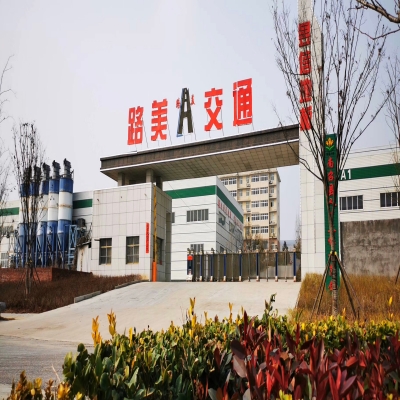
LUMEI Road Marking···
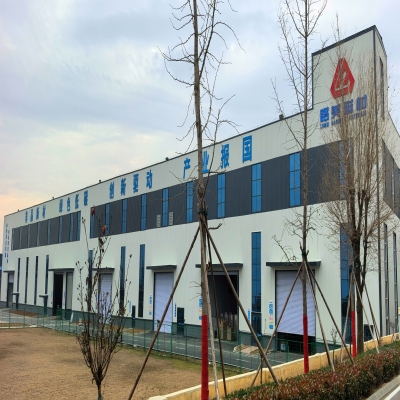
LUMEI Road Marking···
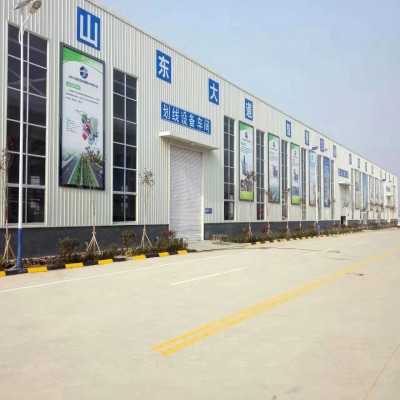
LUMEI Road Marking···
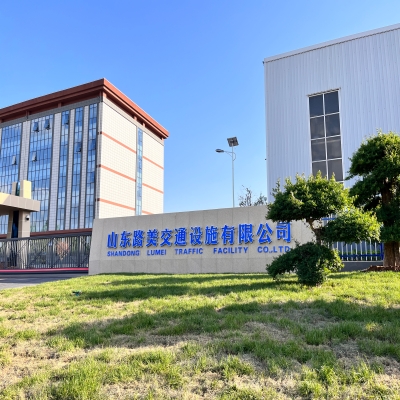
LUMEI Factory and ···
Hot Tags: