
Products Description
Custom-Formula Thermoplastic Road Marking Paint
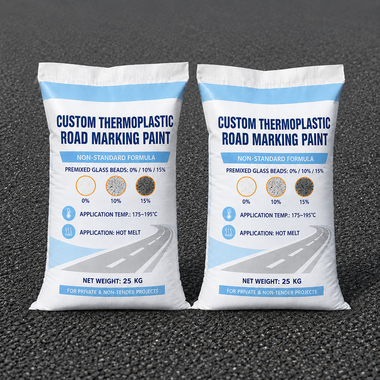
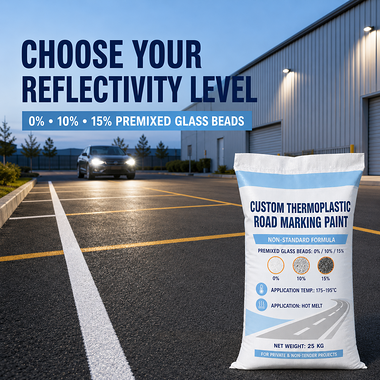
Optional 0%, 10% or 15% Premixed Glass Beads for Private and Non-Tender Projects
🛣️ Product Overview
Custom-Formula Thermoplastic Road Marking Paint is a cost-controlled hot-applied marking material developed for private parking areas, factories, residential communities, industrial compounds and other low-traffic applications.
Unlike products manufactured to a fixed road marking standard, this material can be adjusted according to the buyer’s budget, required color and basic nighttime visibility requirements.
Three premixed glass bead configurations are available:
• 0% premixed glass beads
• 10% premixed glass beads
• 15% premixed glass beads
The product is supplied as a thermoplastic granular or powder mixture. It is heated with suitable hot-melt equipment and forms a solid marking layer after cooling.
This is a non-standard customized product. It is not intended for government tenders, public-highway acceptance projects or applications requiring certification to JT/T 280 or another compulsory standard.
◆ Key Product Advantages
◆ Adjustable Glass Bead Content
The formulation can be supplied without premixed glass beads or with 10% or 15% premixed beads.
This allows buyers to select a configuration according to lighting conditions, expected nighttime traffic and project budget.
Drop-on glass beads are still recommended when initial surface retroreflection is required.
✦ Cost-Controlled Custom Formulation
Buyers do not need to purchase a higher-standard highway formulation for every private-site project.
The product is intended for applications where basic marking visibility, practical wear resistance and flexible purchasing cost are more important than tender compliance.
The final formulation should be confirmed before production.
◈ Suitable for Low-Traffic Private Sites
The product is mainly designed for:
• Private factories
• Residential communities
• Parking areas
• Warehouses
• Logistics compounds
• Internal access roads
• Rural private roads
• Non-tender maintenance work
It should not be presented as a substitute for certified material in regulated public-road projects.
⬢ Stable Hot-Melt Application
The formulation is designed for use with conventional thermoplastic preheating and marking equipment.
When heated and mixed correctly, the material provides workable flow and can form a relatively smooth and cohesive marking layer.
Application performance may vary between the 0%, 10% and 15% glass bead formulations. The operator should follow the technical instructions supplied with the confirmed batch.
🎨 Flexible Color Options
White and medium yellow are the main colors.
Other colors can be evaluated for private-site zoning, parking management and internal safety markings.
Customized colors should be produced against an approved color sample or color reference.
⚙️ General Specifications
Product Name: Custom-Formula Thermoplastic Road Marking Paint
Product Type: Non-Standard Customized Hot-Melt Material
Physical Form: Granular or Powder Mixture
Premixed Glass Beads: Optional 0%, 10% or 15%
Indicative Whiteness: Approximately 70–74
Application Temperature: Approximately 175–195°C
Application Method: Hot Melt
Suitable Surfaces: Asphalt and Properly Prepared Concrete
Standard Colors: White and Medium Yellow
Custom Colors: Available on Request
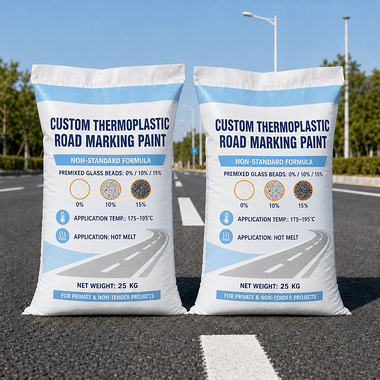
Standard Packaging: 25 kg Woven Bag
Compliance Documentation: Not Available for JT/T 280 Acceptance
Recommended Project Type: Private and Non-Tender Projects
The final specifications must be confirmed according to the selected formulation. Whiteness values should only be compared when the same test method is used.
🔍 Choosing the Glass Bead Configuration
0% Premixed Glass Beads
Suitable for projects that mainly require daytime visual guidance and do not require internal reflective beads.
Drop-on glass beads can still be applied during construction if limited initial surface reflection is needed.
10% Premixed Glass Beads
Suitable for low-speed residential, factory and parking applications requiring an economical improvement in nighttime identification.
The actual reflection depends on bead quality, marking wear, lighting and construction.
15% Premixed Glass Beads
Suitable for private internal roads with more frequent nighttime use or relatively limited fixed lighting.
This option offers greater embedded-bead content than the 10% formulation, but it is still a non-standard customized product and should not be described as meeting a highway reflective specification.
📍 Typical Applications
Recommended applications include:
• Factory internal roads
• Industrial park parking areas
• Residential community roads
• Underground and outdoor parking areas
• Warehouse traffic lanes
• Private logistics compounds
• Private rural access roads
• Non-motorized vehicle lanes
• Internal directional arrows
• Parking-space boundaries
• Restricted parking zones
• Small private marking-renewal projects
Not recommended for:
• Expressways
• National and provincial highways
• Government tender projects
• Municipal acceptance projects
• Airport regulated markings
• Projects requiring certified national-standard material
🧱 Suitable Road Surfaces
Asphalt
The asphalt must be clean, dry, stable and free from dust, oil and loose particles.
A compatible primer may be required on aged or low-adhesion surfaces.
Concrete
Concrete must be fully cured and properly prepared.
Remove laitance, loose material, oil and curing compounds. A compatible road marking primer is normally required to improve adhesion.
Loose, dusty or severely sanded concrete should be repaired before marking.
🔧 Application Guidance
1. Confirm the Selected Formula
Check whether the delivered batch contains 0%, 10% or 15% premixed glass beads.
Do not mix different formulations without technical confirmation.
2. Prepare the Surface
Clean the pavement and ensure that it is dry.
Remove mud, dust, oil, loose particles and standing water.
3. Apply Primer When Necessary
Concrete, aged asphalt and low-adhesion surfaces may require a compatible primer.
Allow the primer to reach the required condition before applying thermoplastic material.
4. Heat Gradually
Heat the material with continuous agitation.
The indicative range is 175–195°C, but the final operating temperature must follow the batch-specific technical instructions.
Avoid insufficient melting and prolonged overheating.
5. Apply the Marking
Use suitable thermoplastic marking equipment.
Control line thickness, width and application speed according to the private-site design.
6. Apply Drop-On Beads
When initial surface reflection is required, apply compatible drop-on glass beads while the marking remains molten.
Premixed glass beads do not eliminate the need for drop-on beads where immediate retroreflection is required.
7. Allow Complete Cooling
Protect the work area until the marking has cooled and hardened.
Reopen the area only after an on-site inspection.
📦 Packaging and Storage
Standard packaging is 25 kg per woven bag.
Each customized batch should be clearly identified by formula, color and premixed glass bead percentage.
Store the product in a dry, ventilated area and protect it from rain, direct sunlight and ground moisture.
Available packaging options include:
• English export packaging
• Neutral packaging
• Private-label packaging
• Formula identification labels
• Customized shipping marks
• Palletized loading
📄 Documentation
Because this is a non-standard customized product, it is not supplied as a JT/T 280-compliant product.
Available commercial documents may include:
• Customized Product Data Sheet
• Batch Formulation Identification
• Factory Batch Inspection Record
• Packing List
• Commercial Invoice
• Export Documentation Support
A JT/T 280 compliance report or national-standard acceptance certificate is not available for this product.
Buyers requiring certified material should select the applicable JT/T 280-2004 or JT/T 280-2022 product instead.
❓ Frequently Asked Questions
Q1: What is the difference between this product and standard thermoplastic paint?
This product uses a customized, non-standard formulation.
Its bead content, whiteness and cost can be adjusted for private-site requirements. It is not produced for regulated public-road acceptance.
Q2: How should I choose between 10% and 15% glass beads?
The 10% option is generally intended for low-speed private areas with basic nighttime identification needs.
The 15% option is more suitable where nighttime use is more frequent or fixed lighting is limited.
Final selection should consider lighting, traffic and budget.
Q3: Does this product pass JT/T 280 testing?
No. It is not manufactured as a JT/T 280-compliant product and should not be submitted for national-standard project acceptance.
Q4: Are drop-on glass beads still necessary?
Yes, when immediate surface retroreflection is required.
Premixed beads are distributed within the material, while drop-on beads create the initial reflective surface.
Q5: Is the construction process different?
The general hot-melt process is similar, but heating behavior may vary with the selected formulation.
Follow the batch-specific temperature and application guidance.
Q6: Can samples be supplied?
A sample based on the selected 0%, 10% or 15% formulation may be arranged for evaluation before bulk ordering.
The buyer can test color, melting behavior and marking appearance under actual conditions.
🤝 Request a Customized Quotation
Please provide:
• Required quantity
• Destination country and port
• 0%, 10% or 15% glass bead option
• Required color
• Private-site application
• Road surface type
• Packaging requirements
• Expected delivery date
Available support includes:
✓ Customized glass bead content
✓ Small-batch formula evaluation
✓ English export packaging
✓ Private-label service
✓ Matching drop-on glass beads and primer
✓ Application guidance
✓ Container loading support
Our factory
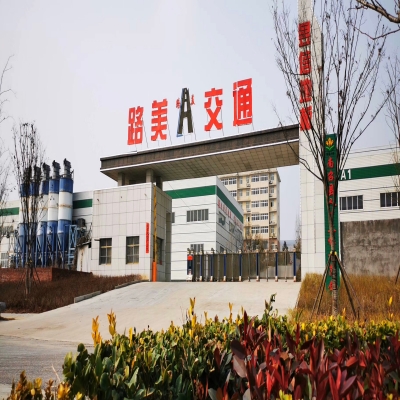
LUMEI Road Marking···
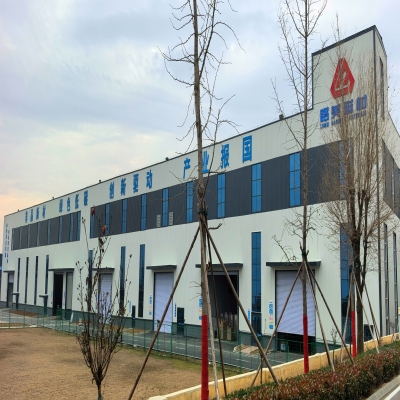
LUMEI Road Marking···
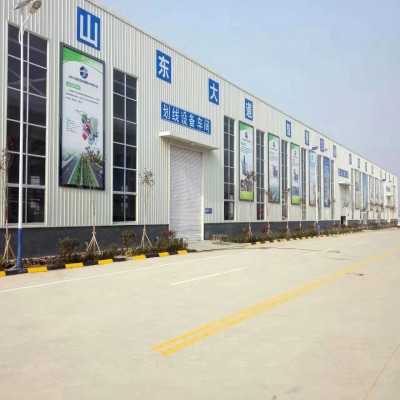
LUMEI Road Marking···
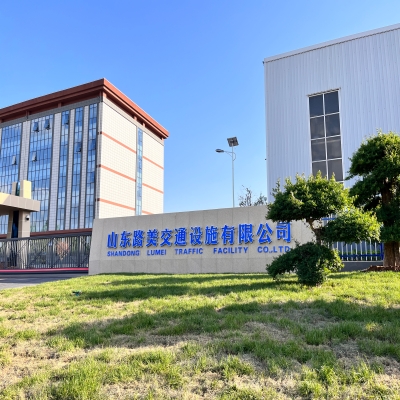
LUMEI Factory and ···
Hot Tags: