Non-Hazardous Thermoplastic Paint Export Technical Guide
1. Core Definition & Global Export Advantage of Non-Hazardous Thermoplastic Marking Paint
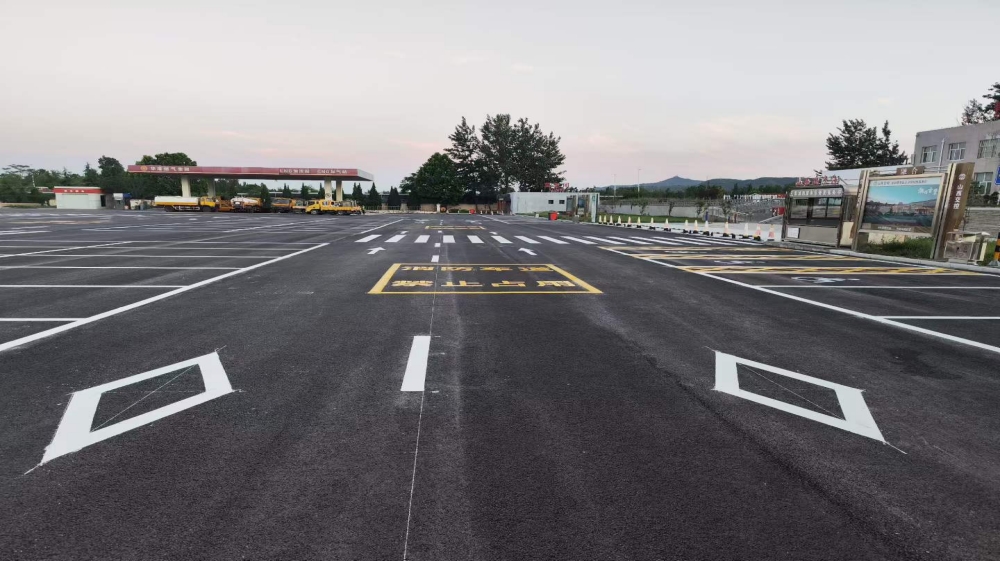
Thermoplastic road marking paint is the dominant material for global highway, urban road, parking lot and traffic safety marking construction. Unlike liquid two-component cold plastic coatings classified as dangerous goods, standard solid thermoplastic hot melt paint formulated without flammable organic solvents is defined as non-hazardous general cargo by UN transport appraisal standards, becoming the first-choice bulk export product for 80% of overseas traffic material importers, foreign trade SOHO and regional trading companies.Traditional solvent-based liquid coatings face multiple export barriers: DG certification fees, special dangerous container surcharges, port inspection detention risks, limited shipping line availability, and strict local VOC import restrictions in EU, Southeast Asia and Gulf countries. Non-hazardous thermoplastic paint eliminates all these pain points, compatible with ordinary 20GP/40GP dry van containers, with simple MSDS and non-danger appraisal documents for customs clearance worldwide.For Chinese export manufacturers and their trade partners, stable low-risk logistics plus long service life performance create dual profit advantages: importers cut 15%–30% extra DG logistics costs annually, while end engineering clients reduce road marking maintenance frequency by 40% compared to low-grade liquid coatings. This market trend makes qualified non-hazardous thermoplastic paint the core long-term bulk order product for cross-border traffic material wholesale business.
2. Standard Low-VOC Non-Hazardous Thermoplastic Paint Raw Material Formula System
A qualified export-grade non-hazardous thermoplastic marking paint relies on a balanced 5-component formula, with strict raw material screening to maintain non-flammable, low-VOC, high-durability properties. Our factory’s trade-exclusive formula is optimized for long ocean transit and diverse global climate conditions:
2.1 Thermoplastic Resin (Binder Base, 32%–38% Ratio)
We adopt fully hydrogenated petroleum resin with softening point controlled at 98℃–105℃, the core binder that determines pavement adhesion and low-temperature crack resistance. For Middle East high-temperature desert regions (ambient peak 55℃), we adjust resin softening point up to 108℃ to prevent marking softening and deformation under extreme heat; for South Asian high-altitude cold zones and northern Southeast Asia rainy areas, low-temperature modified resin (92℃–96℃) is deployed to resist freeze-thaw cracking.Critical non-hazard requirement: No C9 aromatic solvent diluents added; all resin particles are solid granular, zero volatile liquid content to pass UN 38.3 dangerous goods screening tests.
2.2 Inorganic Filler System (Calcium Carbonate + Talc Powder, 40%–45% Ratio)
High-whiteness heavy calcium carbonate (400–800 mesh) and layered talc powder form the main filler, controlling paint hardness, wear resistance and raw material cost balance. Export batches use surface-coated hydrophobic filler to reduce moisture absorption during long sea storage—moisture content strictly limited below 0.3% before packaging to avoid bag bulging and agglomeration in humid container holds.Heavy metal content (lead, chromium, mercury) is tested per EU REACH and ASEAN green building standards, fully compliant for municipal green road projects overseas, a key selling point for trade partners bidding government infrastructure tenders.
2.3 High Refractive Index Glass Beads (10%–15% Ratio)
Two-grade mixed glass bead formula for stable nighttime reflectivity: 30% large-size pre-mixed beads (800–1200μm) for initial retroreflectivity, 70% medium fine beads (200–600μm) for embedded long-term reflection retention. Reflective index ≥1.50, meeting EN 1423 (EU) and AASHTO M247 (US) international marking standards.For high-traffic expressway export orders, we increase bead proportion to 18% to extend reflective lifespan to 24–30 months; low-traffic residential/parking lot batches use 10% bead loading to optimize unit cost for price-sensitive small importers.
2.4 Functional Additives (3%–5% Total)
Anti-oxidant: Hindered phenol composite additive, prevents resin aging yellowing under strong UV sunlight (critical for Middle East, Africa tropical markets)
Anti-settling agent: Polyethylene wax powder, stops glass bead sinking during high-temperature melting construction
Flexibility modifier: EVA copolymer wax, boosts low-temperature ductility without introducing flammable solventsAll additives are solid powdery, no liquid solvent carriers—ensuring the finished paint maintains non-hazardous transport classification after full mixing.
2.5 Color Pigment (2%–4% Ratio)
Inorganic rutile titanium dioxide (white) and iron oxide pigments (yellow, red, blue, green) are used, fade-resistant for 3+ years outdoor exposure. No organic azo pigments prone to UV degradation; color tolerance controlled within ΔE≤2 for consistent batch color matching, essential for chain parking lot and municipal standard road projects abroad.
3. Full Production Process Control To Guarantee Non-Hazard & Export Batch Consistency
Unstable production workflow causes batch quality deviation, which leads to overseas buyer complaints, customs hold-ups or contract compensation losses for trade SOHO and trading companies. Our automated closed production line enforces 6 key QC checkpoints exclusive for export orders:
Raw Material Incoming Inspection: Every resin, filler and additive batch submits COA test reports; lab re-tests softening point, moisture, VOC and heavy metal content before unloading into silos. Failed raw materials are rejected entirely, no blending allowed.
Closed High-Temperature Mixing (160℃–180℃): Fully sealed stainless steel mixing kettles eliminate solvent volatilization risks; real-time temperature sensors prevent overheating resin decomposition. Mixing duration fixed at 45 minutes per batch for uniform component dispersion.
Cooling & Crushing Granulation: Hot molten mixture is cooled via water-free air conveyor to avoid moisture absorption, crushed into uniform 2–5mm granular paint (ideal for automatic road marking machine feeding overseas).
Finished Product Lab Sampling (1 Sample Per 5 Ton Batch): Test items include softening point, melt flow rate, reflectivity, low-temperature bending crack test, VOC emission value and non-hazard transport appraisal repeat verification.
Export-Grade Packaging Line: 25kg kraft paper bags with double PE inner moisture-proof liner, heat-sealed top, woven strap pallet binding. Pallets are stretch-wrapped with UV-resistant film for sea stack protection; each bag printed with batch number, production date, climate formula code and UN non-hazard marking labels.
Pre-Load Container Inspection QC: Before forklift stuffing, QC team spot-check pallet bag integrity, seal tightness and batch document matching; damp or damaged bags are repacked to prevent ocean water intrusion damage.
Daily production capacity for export non-hazardous thermoplastic paint reaches 220 tons, capable of simultaneously scheduling thousand-ton annual framework orders, medium replenishment batches and small 1×20GP trial shipments for new SOHO partners, with dedicated production line priority for long-term trade contract clients.
4. Climate-Adapted Custom Formula Solutions For Major Global Export Markets
Different regional climate and construction standards demand tailored formula tuning—this customized technical service is a core competitive advantage our trade partners leverage to beat generic low-quality Chinese suppliers in overseas wholesale markets:
4.1 Middle East (Saudi, UAE, Oman, Kuwait)
Core pain points: Extreme high heat (road surface 60℃+), intense UV radiation, low rainfall, sand abrasionOptimized formula: High softening point resin (106℃–108℃), extra anti-oxidant additive, 15% glass bead ratio, high-hardness talc filler. Paint marking resists softening, yellowing and sand wear, service life ≥28 months on arterial highways.Export logistics: Full non-hazard documents, FOB Qingdao/Lianyungang port delivery, stable weekly liner vessel schedules to Gulf ports.
4.2 Southeast Asia (Vietnam, Thailand, Malaysia, Indonesia, Philippines)
Core pain points: Year-round high humidity, monsoon heavy rain, alternating hot/cool temperatures, coastal salt spray corrosionOptimized formula: Hydrophobic coated filler, flexible EVA modifier, anti-salt-spray additive, medium 12% glass bead loading. Prevents blistering, peeling and salt-induced discoloration on coastal expressways and city roads.Low-VOC formula meets ASEAN green construction codes, no local environmental import filing barriers.
4.3 South Asia (India, Bangladesh, Sri Lanka, Nepal)
Core pain points: Monsoon flooding, cold winter highland zones, budget-sensitive municipal projectsTwo tiered formulas supplied:
Premium highway grade: High flex resin, 14% glass beads for national highway tender projects
Economy municipal grade: Balanced filler ratio, 10% glass beads for town roads, parking lots—cost-optimized for price-competitive local wholesaleBoth tiers retain full non-hazardous general cargo shipping status.
4.4 Africa & Eastern Europe
Africa (Nigeria, Kenya, Ghana): High UV, rough aggregate asphalt roads → high wear-resistance filler formulaEastern Europe (Poland, Romania, Bulgaria): Severe winter freeze-thaw → low-temperature flexible modified resin formula
5. Complete One-Stop Export Technical & Document Support For Foreign Trade SOHO & Trading Companies
Most small-scale SOHO and medium trading firms lack professional traffic paint export operation teams; our factory provides full backend technical and paperwork support to cut your operational workload by 80%:
5.1 Official Non-Hazardous Certification Documents (Provided Free With Every Shipment)
UN transport non-dangerous goods appraisal report
Full MSDS safety data sheet (English version, compliant with GHS global standards)
Batch COA certificate of analysis matching loaded goods batch number
JT/T 280 national industry test report, EN 1423 / AASHTO international standard test copies
Packing list, commercial invoice, certificate of origin for customs clearance & tariff preferential filing (CEPA, ASEAN, etc.)
5.2 Pre-Sale Technical Service
Free customized formula sample production (1–2kg test samples shipped to buyer’s lab for performance verification)
Detailed technical datasheet (TDS) with melting temperature, construction thickness, application rate per square meter
Construction parameter guide for local marking machine operators (melting temp 180–200℃, standard coating thickness 1.8–2.0mm for highway)
5.3 After-Sales Technical Support
24-hour online bilingual technical engineer consultation for construction troubleshooting
Remote video guidance for overseas project marking teams
For annual orders over 1000 tons: Optional cross-border on-site engineer technical training at buyer’s construction base
Batch quality traceability system: Every pallet batch number linked to full production and lab test archives for 3-year record storage
6. Cost & Risk Comparison: Non-Hazardous Thermoplastic VS Two-Component Liquid Marking Paint For Export
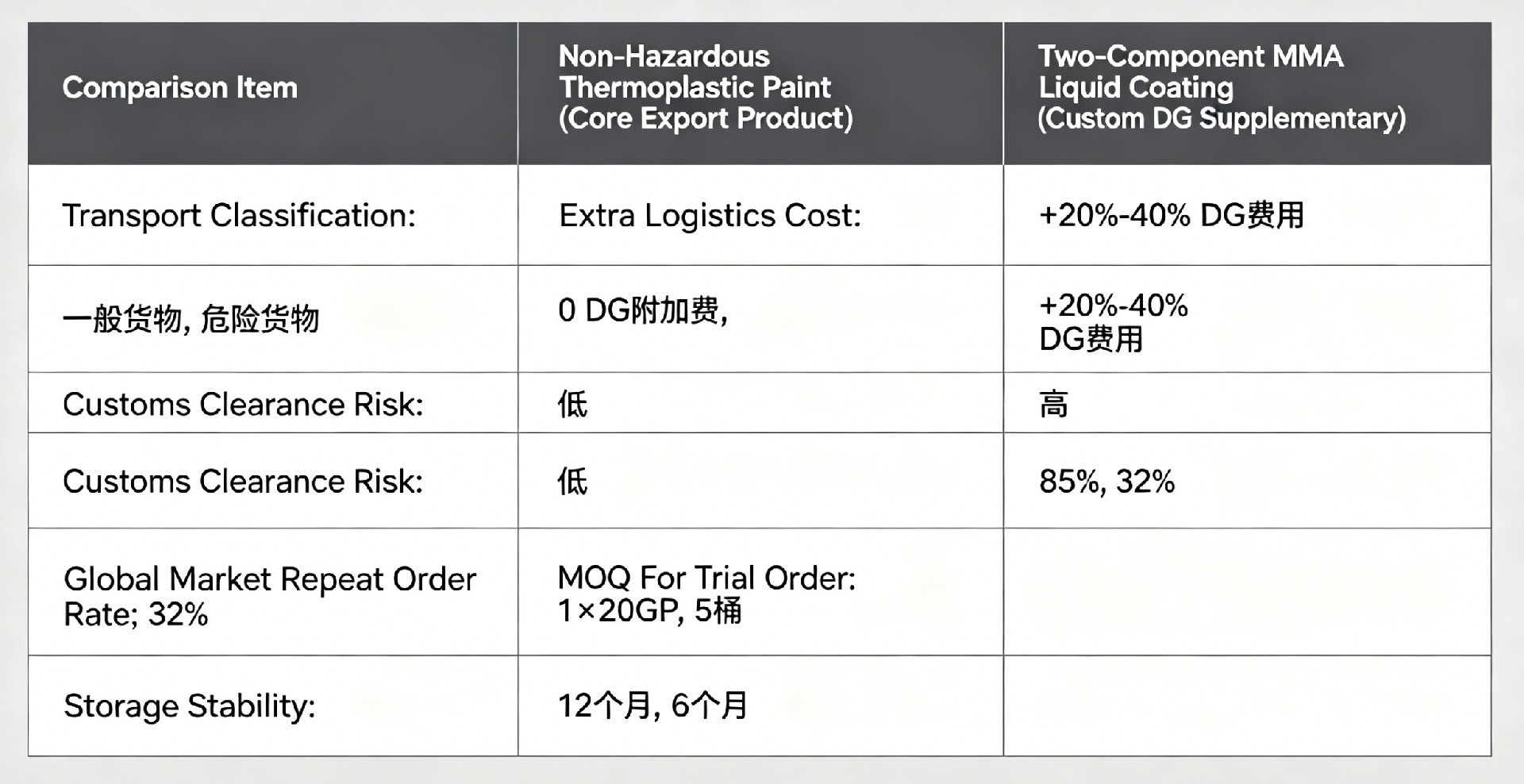
For 90% of long-term bulk export wholesale business targeting steady repeat stocking, non-hazardous thermoplastic paint delivers far lower operational risk and higher sustainable profit margins for foreign trade operators. Two-component liquid coating is only recommended for confirmed high-budget heavy-traffic highway tender projects with pre-approved DG import permits in the destination country.
7. How To Select A Reliable Non-Hazardous Thermoplastic Paint Factory For Long-Term Export Cooperation
When sourcing manufacturing partners for cross-border bulk supply, trade SOHO and companies must verify 6 critical factory technical capacities to avoid quality and shipment risks:
Independent full automated mixing production lines (no outsourced blending) to guarantee batch formula consistency
In-house physical & chemical testing laboratory with full set reflectivity, softening point, low-temperature crack test equipment
Official annual UN non-hazardous transport appraisal qualification for thermoplastic paint
Proven export case records to your target market country (verifiable container loading photos, bill of lading archives)
Dedicated bilingual foreign trade & technical support team familiar with global customs document requirements
Flexible order scheduling capacity for mixed trial batches and large annual framework tonnage
Lumei Traffic, with 28 years of traffic new material R&D and production experience, meets all six standards, with over 1400-ton large-batch export shipment records to Middle East, Southeast Asia and South Asian markets, and Intertraffic 2026 Net-Zero Pioneer green product certification for low-VOC eco-grade thermoplastic formulas. We tailor exclusive long-term cooperation pricing frameworks for stable foreign trade SOHO and trading company partners, with locked tiered volume discounts for annual bulk order contracts.
Non-hazardous low-VOC thermoplastic road marking paint remains the backbone of profitable, low-risk bulk export business for global traffic material trade operators. Its balanced formula system, controllable automated production QC, climate-customized tuning and complete export document support solve the core pain points of DG logistics risk, unstable batch quality and complex backend operation for foreign trade SOHO and trading firms.
By partnering with a technically mature, certified large-scale manufacturer with verified overseas shipment track records, trade partners can focus fully on expanding overseas importer client resources, while the factory undertakes formula R&D, production quality control, packaging and full export paperwork coordination. As global road infrastructure investment expands across Middle East, Southeast Asia and South Asia, high-quality non-hazardous thermoplastic marking paint will maintain dominant market share for cross-border wholesale traffic material trade in the long term.