In the global infrastructure development landscape of 2026, road safety, durability, and environmental sustainability have become the core benchmarks for evaluating road construction materials. Among numerous traffic safety products, thermoplastic road marking paint and colored ceramic granules stand out as the preferred solutions for modern road projects worldwide, especially in Southeast Asia, the Middle East, and Africa. These two materials not only meet the stringent requirements of international standards such as AASHTO M249 and BS 3262 but also address key industry pain points including short service life, poor reflectivity, and high VOC emissions. As a professional China manufacturer and supplier of traffic safety materials, we will conduct an in-depth analysis of the technical advantages, application scenarios, market trends, and selection criteria of these two core products, providing authoritative reference for global road construction contractors, government procurement departments, and engineering planners.
1. Thermoplastic Road Marking Paint: The Gold Standard for Durable & Reflective Road Markings
1.1 What Is Thermoplastic Road Marking Paint?
Thermoplastic road marking paint, also known as hot melt marking paint, is a powder-based traffic marking material composed of synthetic resins, pigments, fillers, and reflective glass beads. It is applied by heating the powder to 180–220°C (356–428°F) using a hot melt kettle until molten, then spraying or scraping it onto asphalt or concrete road surfaces. After cooling for 3–5 minutes, it forms a thick, solid polymer layer with a thickness of 1.5–2.5mm, achieving permanent bonding with the road substrate. This material has a history of decades of application globally and has been continuously optimized to become the most widely used high-performance marking paint in the 2026 road construction industry.
1.2 Core Technical Advantages of Thermoplastic Road Marking Paint
1.2.1 Exceptional Durability & Long Service Life
Durability is the most prominent advantage of thermoplastic road marking paint. Its molten resin forms a tough, wear-resistant layer that can withstand the friction and impact of heavy traffic, high-temperature baking in summer, and freezing in winter. Field application data shows that the service life of thermoplastic markings can reach 2–5 years, 3–5 times longer than traditional water-based paint (less than 1 year) and solvent-based paint (1–2 years). In high-traffic scenarios such as highways, urban main roads, and port terminals, its anti-aging and anti-deformation capabilities are particularly outstanding, significantly reducing the frequency of repainting and maintenance costs.
1.2.2 Superior Reflectivity for Night Safety
Night traffic safety depends heavily on the reflectivity of road markings. Thermoplastic road marking paint is embedded with high-quality reflective glass beads (either pre-mixed in the paint or spread on the surface during construction). When vehicle headlights shine on the marking surface, the glass beads reflect light back to the driver’s line of sight, ensuring excellent visibility at night, in rainy, foggy, or low-light conditions. The retroreflectivity coefficient of qualified thermoplastic markings can reach over 300 mcd·m⁻²·lx⁻¹, meeting the highest standards of international traffic safety norms and effectively reducing night traffic accidents.
1.2.3 Climate Adaptability for Global Applications
2026’s global road construction projects cover diverse climatic zones, from tropical Southeast Asia (high temperature and humidity) to cold Northern Europe (extreme freezing), and from arid deserts in the Middle East to rainy coastal areas. Thermoplastic road marking paint has excellent climate adaptability: it resists deformation at high temperatures (80°C) and cracking at low temperatures (-40°C), maintaining stable performance in harsh environments. It also has strong resistance to salt spray, oil pollution, and ultraviolet radiation, avoiding fading and peeling caused by long-term exposure to the natural environment.
1.2.4 Fast Drying & Minimal Traffic Disruption
Road construction and maintenance often face the challenge of traffic congestion. Thermoplastic road marking paint has a fast-drying feature: after construction, it can be opened to traffic within 3–5 minutes, minimizing the impact on road traffic and improving construction efficiency. This advantage is particularly critical for urban road renovation and expressway maintenance projects, helping to reduce social costs and traffic pressure.
1.2.5 Cost-Effective Lifecycle Value
Although the initial material cost of thermoplastic road marking paint (USD 270–700 per ton) is higher than that of traditional paint, its long service life significantly reduces the total lifecycle cost. Calculations show that over five years, thermoplastic markings can reduce comprehensive costs by up to 40% compared to water-based paint, saving a great deal of labor, equipment, and road closure expenses. For government projects and large-scale infrastructure construction, this economic advantage becomes a key factor in material selection.
1.3 Main Types & Application Scenarios of Thermoplastic Road Marking Paint
1.3.1 Classification by Formula & Performance
Standard Thermoplastic Paint: The most common type, with balanced performance of wear resistance, reflectivity, and price, suitable for highways, urban roads, and parking lots.
High-Visibility Reflective Paint: Added with high-refractive-index glass beads and special pigments, with higher retroreflectivity, suitable for high-speed roads, intersections, and dangerous sections.
Anti-Skid Thermoplastic Paint: Mixed with anti-slip particles (such as ceramic sand), increasing the friction coefficient of the marking surface, suitable for ramps, curves, and pedestrian crossings.
Eco-Friendly Low-VOC Thermoplastic Paint: Adopts lead-free pigments and bio-based resins, with low volatile organic compound emissions, meeting the environmental protection requirements of Europe, North America, and other regions.
1.3.2 Key Application Scenarios
Highways & Expressways: Lane dividers, edge lines, and warning lines, ensuring high-speed driving safety and durability.
Urban Roads & Intersections: Crosswalks, stop lines, directional arrows, and traffic signal markings, standardizing urban traffic order.
Parking Lots & Garages: Parking space lines, traffic guidance lines, and safety warning lines, improving parking management efficiency.
Airports & Ports: Runway markings, taxiway lines, and cargo area markings, meeting the high-load and high-safety requirements of special scenarios.
Residential Areas & Parks: Slow traffic lines, pedestrian paths, and warning markings, ensuring the safety of residents and tourists.
1.4 2026 Market Trends for Thermoplastic Road Marking Paint
1.4.1 Green & Low-VOC Transformation
With the continuous tightening of global environmental protection regulations, low VOC and eco-friendly thermoplastic road marking paint has become the mainstream trend in 2026. More than 18 countries have updated their environmental policies to favor low-emission marking materials, and traditional solvent-based paint is being phased out. Leading manufacturers (including our company) are actively developing lead-free pigments, bio-based resins, and meltable biodegradable packaging to reduce the carbon footprint of products while ensuring performance.
1.4.2 Intelligent & Functional Upgrading
The development of smart transportation and autonomous driving technology has driven the intelligent upgrading of thermoplastic marking paint. In 2026, products with functions such as temperature-sensitive discoloration, self-luminescence, and machine vision recognition have entered the pilot stage, supporting the construction of smart roads and vehicle-road collaboration systems. In addition, preformed thermoplastic markings (suitable for complex patterns and symbols) have seen a 14% increase in market adoption due to their convenient construction and high durability.
1.4.3 Strong Demand in Emerging Markets
Southeast Asia, the Middle East, and Africa have become the core growth markets for thermoplastic road marking paint in 2026. These regions are vigorously promoting infrastructure construction, with huge demand for high-performance and cost-effective road marking materials. For example, Vietnam, Thailand, and Malaysia are upgrading their highway networks, while countries in the Middle East (such as Saudi Arabia and the UAE) are building smart cities, all of which require a large amount of thermoplastic marking paint that adapts to high temperatures and humidity.
2. Colored Ceramic Granules: Innovative Anti-Slip & Decorative Road Material
2.1 What Are Colored Ceramic Granules?
Colored ceramic granules are a new type of eco-friendly road surface material, made from kaolin, feldspar, quartz, and clay as raw materials, adding inorganic high-temperature colorants, and sintered at high temperatures (over 1200°C). The particles are 1–5mm in size, with a Mohs hardness of 7–8 (harder than ordinary asphalt and concrete), and available in red, yellow, green, blue, white, and other colors. They are laid on the road surface using modified emulsified resin or polyurethane resin as a binder, forming a thin-layer colored anti-slip pavement with a thickness of 3–5mm. As a multifunctional road material, it integrates anti-slip safety, decorative aesthetics, and environmental protection, and is widely used in various scenarios in 2026.
2.2 Core Advantages of Colored Ceramic Granules
2.2.1 Outstanding Anti-Slip Performance (Core Advantage)
Safety is the primary goal of road design, and colored ceramic granules excel in anti-slip performance. The high-hardness ceramic particles form a rough surface, with a wet BPN anti-slip value of ≥75, far exceeding that of ordinary asphalt (≤50). The surface has a structural depth of about 1.5mm, which can quickly drain rainwater, reduce water splashing, and shorten the braking distance by 40%–45%, effectively reducing the risk of skidding and rear-end collisions in rainy days. They are especially suitable for accident-prone sections such as curves, ramps, tunnel entrances, bus stops, and bridge decks.
2.2.2 Durability & Long Service Life
Colored ceramic granules have extremely high wear resistance and weather resistance, with a service life of 8–15 years, 2–3 times longer than that of ordinary colored pavement (3–5 years). They can withstand extreme temperature changes from -40°C to 80°C, resist ultraviolet radiation, oil pollution, and chemical corrosion, and do not fade, crack, or peel after long-term use. In addition, the waterproof sealing performance of the granular pavement can isolate rainwater, delay the aging of the original road surface, and play a protective role on the road base layer.
2.2.3 Bright Color & Decorative Aesthetics
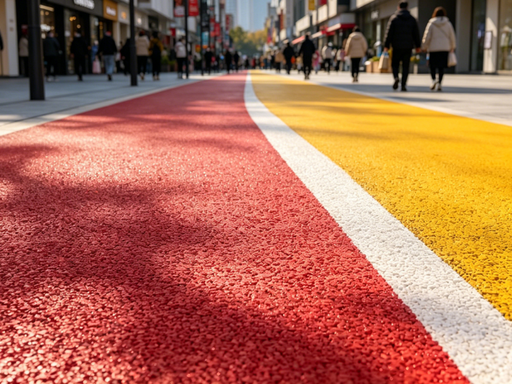
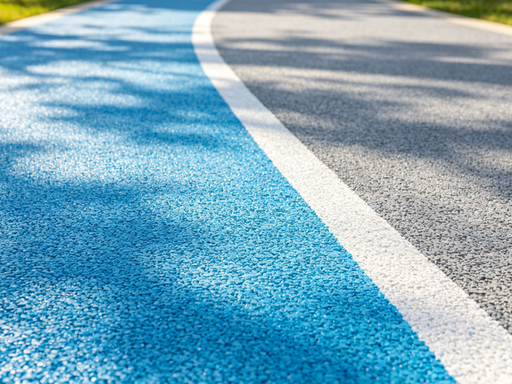
Different from the single black of traditional asphalt pavement, colored ceramic granules have rich and bright colors, and the inorganic colorants sintered at high temperatures are resistant to fading, maintaining long-term color vividness. Through color matching and particle size design, they can realize functional zoning and landscape integration of roads, beautify the urban environment, and enhance the visual recognition of roads. For example, red can be used for bus lanes, green for pedestrian paths, and blue for slow traffic lanes, while also creating unique landscape roads in parks, scenic areas, and residential areas.
2.2.4 Environmental Protection & Low Noise
Colored ceramic granules are an eco-friendly material, mostly made from industrial waste (such as ceramic waste and broken glass), which conforms to the concept of circular economy. The open-pore structure of the granular pavement helps rainwater infiltration, alleviates urban waterlogging, and supports the construction of sponge cities. In addition, the unique surface structure can effectively reduce the noise generated by tires rolling on the ground, with a noise reduction effect of 5–8 decibels, improving the comfort of the road environment.
2.2.5 Fast Construction & Wide Adaptability
The construction process of colored ceramic granules is simple and efficient: after cleaning the original road surface, apply a binder, spread the granules, and roll them flat. The construction can be completed in a short time, and the road can be opened to traffic within 24 hours, with minimal impact on traffic. They can be laid on various substrates such as asphalt, concrete, and cement, and are suitable for both new roads and old road renovation projects, with strong adaptability.
2.3 Main Application Scenarios of Colored Ceramic Granules
Anti-Slip Safety Sections: Curves, steep ramps, tunnel entrances/exits, bridge decks, and bus stops, reducing accident risks.
Functional Zoning Roads: Bus exclusive lanes, bicycle lanes, pedestrian streets, and school zone roads, improving traffic management efficiency.
Landscape & Leisure Areas: Park paths, scenic area roads, community trails, and square pavements, enhancing the aesthetic value of the environment.
Special Purpose Roads: Airport runways, port cargo areas, and factory passages, meeting the requirements of anti-slip, wear resistance, and oil pollution resistance.
Urban Beautification Projects: Urban arterial roads, landscape belts, and commercial street pavements, enhancing the overall image of the city.
2.4 2026 Market Demand & Development Potential
In 2026, with the acceleration of urbanization and the improvement of road safety standards, the market demand for colored ceramic granules is showing a rapid growth trend. Governments of various countries are increasing investment in road safety and urban beautification projects, and colored ceramic granules, as a multifunctional material that meets both safety and aesthetic needs, are widely promoted. Especially in Southeast Asia, the Middle East, and other regions with high temperatures and rainy weather, their anti-slip and weather resistance advantages are particularly prominent, and the market potential is huge. In addition, with the development of green building and sponge city construction, the environmental protection characteristics of colored ceramic granules will further drive their market expansion.
3. How to Choose the Right Road Safety Materials: Thermoplastic Paint vs. Colored Ceramic Granules
3.1 Selection Based on Application Scenarios
For Highways & High-Speed Roads: Prioritize thermoplastic road marking paint (focus on reflectivity and durability).
For Anti-Slip & Safety-Critical Sections (Curves, Ramps): Choose colored ceramic granules (focus on anti-slip performance).
For Urban Roads & Functional Zoning: Combine both: use thermoplastic paint for markings and colored ceramic granules for functional lanes.
For Landscape & Leisure Areas: Prioritize colored ceramic granules (focus on aesthetics and comfort).
3.2 Selection Based on Performance Requirements
Core Requirement: Durability & Long Service Life: Both are excellent, with colored ceramic granules (8–15 years) outperforming thermoplastic paint (2–5 years).
Core Requirement: Night Reflectivity: Thermoplastic road marking paint (with glass beads) is irreplaceable.
Core Requirement: Anti-Slip Safety: Colored ceramic granules are the best choice.
Core Requirement: Environmental Protection: Both meet low-VOC standards; colored ceramic granules have better eco-friendly performance (waste recycling, rainwater infiltration).
3.3 Selection Based on Budget & Lifecycle Cost
Short-Term Project & Limited Budget: Choose thermoplastic road marking paint (lower initial cost).
Long-Term Project & Focus on Comprehensive Cost: Choose colored ceramic granules (lower long-term maintenance cost).
Large-Scale Infrastructure: Adopt a combination solution to balance performance and cost.
4. Why Choose Us as Your Reliable China Supplier
As a professional manufacturer and supplier of thermoplastic road marking paint and colored ceramic granules in China, we have been deeply engaged in the traffic safety materials industry for many years, with independent R&D capabilities, advanced production equipment, and a strict quality control system. All products comply with international standards such as AASHTO M249, BS 3262, and ISO 14001, and have been exported to more than 50 countries and regions worldwide, including Southeast Asia, the Middle East, Africa, Europe, and America, winning wide recognition from customers.
4.1 Our Core Advantages
High-Quality Products: Adopt high-purity raw materials and advanced production technology to ensure that each batch of products has stable performance, meeting the highest standards of durability, reflectivity, and environmental protection.
Customized Solutions: According to customers' application scenarios, climatic conditions, and budget requirements, we provide one-stop customized material selection and construction guidance solutions.
Competitive Price: As a direct manufacturer, we eliminate intermediate links, providing customers with the most favorable factory prices while ensuring product quality.
Fast Delivery: With a large production capacity and a complete supply chain system, we can meet customers' bulk order demands and ensure timely delivery.
Professional After-Sales Service: Provide 24/7 technical support and after-sales service, including construction training, quality problem solving, and product maintenance guidance, to ensure customers' worry-free use.
4.2 Our Main Products & Specifications
4.2.1 Thermoplastic Road Marking Paint
Color: White, yellow, red, green, etc. (customizable).
Packaging: 25kg/bag (meltable biodegradable packaging).
Specifications: Standard type, high-reflective type, anti-slip type, low-VOC eco-friendly type.
Certifications: AASHTO M249, BS 3262, ISO 14001, CE.
4.2.2 Colored Ceramic Granules
Color: Red, yellow, green, blue, white, etc. (customizable).
Particle Size: 1–3mm, 3–5mm (customizable).
Specifications: High-hardness anti-slip type, weather-resistant type, eco-friendly type.
Certifications: ISO 9001, ISO 14001, CE.
Conclusion
In 2026, under the dual drive of global infrastructure development and road safety improvement, thermoplastic road marking paint and colored ceramic granules will continue to be the core materials in the road construction industry, playing an irreplaceable role in ensuring road safety, extending road service life, and promoting environmental sustainability. As a reliable China manufacturer and supplier, we are committed to providing global customers with high-quality products, professional solutions, and excellent services, helping to build safer, more durable, and greener road infrastructure.
Whether you are a road construction contractor, a government procurement department, or an engineering planner, if you are looking for high-performance thermoplastic road marking paint and colored ceramic granules, please contact us now. We will provide you with a free quotation and professional technical consultation, and look forward to establishing a long-term cooperative relationship with you to create a better future for global road safety!
Keywords: thermoplastic road marking paint, colored ceramic granules, road marking paint, reflective road paint, traffic marking paint, anti-slip ceramic granules, road construction materials, China supplier, low VOC road marking paint, highway marking paint