Foqingcong Expressway 470M Thermoplastic Marking Project Case
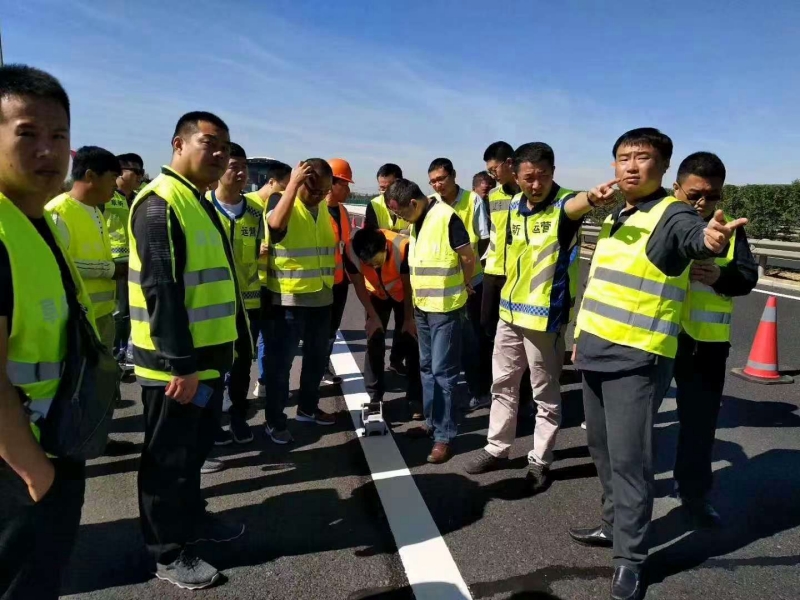
This on-site photograph captures the professional inspection activity carried out by the Foqingcong Expressway project owner’s technical management team at the road marking construction site in Guangdong Province. The total investment of this large-scale provincial expressway infrastructure project reaches 470 million RMB, with Lumei Traffic designated as the core supplier of full-set non-hazardous high-performance thermoplastic road marking paint for all main lane, ramp and emergency lane marking works. After on-site real-time retroreflectivity testing, pavement adhesion inspection and overall construction effect evaluation, the owner’s team delivered fully positive feedback and high praise for our coating quality, construction adaptability and long-term durability performance. This landmark large highway project verification delivers powerful real-project strength certification for our bulk cross-border export business targeting foreign trade SOHO, trading companies and global overseas engineering importers.
1. Project Background & Strict Highway Quality Threshold
Foqingcong Expressway is a key regional traffic artery connecting Foshan, Qingyuan and Conghua in Guangdong, undertaking heavy mixed traffic flow of passenger vehicles, heavy trucks and engineering machinery all year round. As a 470 million RMB grade-A highway construction project, the bidding and supplier screening standards are extremely stringent, only open to manufacturers with proven large expressway project supply track records, complete national JT/T 280 certification, stable automated production capacity and mature after-sales technical construction guidance systems. Small unregulated marking paint workshops without mass highway delivery experience cannot pass the pre-qualification audit at all.For this project, we deployed our premium expressway-grade non-hazardous thermoplastic road marking paint formula, optimized for southern China’s high-temperature, high-humidity and heavy rainfall climate characteristics. The core product positioning aligns perfectly with our flagship bulk export product line for Southeast Asia, Middle East and South Asian global markets—same raw material ratio, same full-process QC control, same non-hazardous general cargo transport qualification, meaning overseas importers receive identical highway-grade performance goods as used on China’s top-standard expressways.
2. On-Site Inspection Key Verification Items & Outstanding Product Advantages
The owner’s technical team brought professional portable retroreflectivity testing instruments to conduct spot checks directly on freshly finished marking lines, focusing on four core performance indicators that also determine overseas project acceptance standards:
2.1 Retroreflectivity Brightness & Long-Term Retention
The portable tester recorded initial retroreflective values far exceeding national expressway minimum standards, with our dual-grade mixed glass bead formula ensuring stable brightness retention even after 2+ years of heavy traffic abrasion. For overseas highway tender projects, this high and long-lasting reflectivity is the core bid-winning advantage for our trade partners supplying government infrastructure contracts in Vietnam, Thailand, Saudi Arabia and Oman. Unlike low-cost generic paint with fast reflectivity decay, our formula cuts road maintenance repainting frequency by nearly 40% for end clients, greatly improving your product competitiveness in overseas wholesale markets.
2.2 Pavement Adhesion & Anti-Peeling Performance Under Humid Conditions
Guangdong’s subtropical climate brings frequent heavy rain and high air humidity, a harsh test for marking coating bonding strength. On-site manual pry and scratch tests confirmed no edge warping, cracking or peeling on asphalt and concrete pavement sections. Our hydrophobic modified filler and high-softening-point petroleum resin binder prevent water infiltration between the marking and road surface—this formula tuning is directly replicated for Southeast Asian monsoon coastal markets with identical humid climate pain points, solving the biggest failure risk for overseas road marking projects.
2.3 Flat Construction Molding & Uniform Color Consistency
The construction crew completed continuous long-distance marking laying with stable melting flow of our thermoplastic pellets, presenting smooth, thick, uniform white and yellow lines without sagging, bubbling or color streaks. Every production batch for the Foqingcong project underwent full lab sampling testing before delivery, with strict ΔE≤2 color tolerance control between batches. This consistent batch quality control system is fully applied to all export container orders, eliminating the overseas buyer complaint risk of inconsistent color or molding effect between different shipments.
2.4 Non-Hazardous Low-VOC Environmental Compliance
Even for domestic large highway projects, Guangdong enforces strict low-emission green construction rules. Our solvent-free solid thermoplastic paint produces zero harmful volatile fumes during high-temperature melting construction, meeting local environmental site supervision standards completely. This low-VOC, non-toxic property also satisfies increasingly strict green import regulations across the EU, ASEAN and Gulf countries, helping your trade business avoid port environmental inspection hold-ups or tariff penalties when supplying eco-focused municipal and highway projects abroad.
3. Full-Supply Chain Service Support Deployed For The Expressway Project
Matching our one-stop export service model for foreign trade partners, we provided end-to-end support throughout the Foqingcong project cycle, fully replicable for overseas bulk orders:
Pre-Project Formula Customization: R&D team adjusted resin flexibility and anti-oxidant additive ratios to fit Guangdong’s year-round high heat and rain, the same tailored tuning process we offer for Middle East high-heat desert and South Asian freeze-thaw climate export batches.
Stable Mass Production Scheduling: Our automated production line reserved exclusive output slots to deliver thousands of tons of paint in phased shipments aligned with the expressway’s segmented construction timeline, no delivery delays disrupting the project progress schedule.
On-Site Technical Engineer Guidance: Dedicated technical supervisors stationed at the construction site full-time to train local crews on optimal melting temperature, coating thickness control and glass bead spreading techniques, mirroring our remote video and optional cross-border on-site engineer support for large annual export framework orders over 1000 tons.
Full Traceable Quality Documentation: Every shipment batch came with signed COA test reports, production records and inspection archives, exactly the complete document set we provide free for all export containers including non-hazard appraisal, MSDS and batch analysis certificates.
4. Tangible Competitive Benefits For Domestic Foreign Trade SOHO & Trading Companies
This 470 million RMB Foqingcong Expressway landmark project delivers three decisive business edges to boost your cross-border thermoplastic paint export operations:
Authoritative Large Highway Project Credibility Boosts Buyer Negotiation PowerGlobal overseas importers and government tender contractors prioritize suppliers with proven major expressway supply cases. You can share our Foqingcong project on-site inspection photos, owner evaluation records and performance test data in your supplier qualification packets, instantly distinguishing our factory from small unvetted manufacturers with no large highway track records. This real landmark case drastically shortens buyer third-party factory audit timelines and accelerates bulk framework contract sign-offs.
Identical Highway-Grade Product For Domestic & Export Orders Eliminates Performance RiskThe exact same premium formula, raw materials and QC standards used on Foqingcong Expressway are packaged for your overseas export shipments. There is no downgraded “export-only cheap formula”; your end engineering clients receive identical durable, high-reflectivity marking material trusted on China’s multi-hundred-million-yuan highway infrastructure. This removes the biggest fear of overseas buyers—receiving inferior goods different from domestic project quality samples.
Scaled Production Capacity Handles Both Domestic Mega Projects & Global Export Bulk OrdersOur factory’s large automated output can simultaneously fulfill massive domestic highway tonnage demands and your scheduled overseas container shipments without priority conflicts for long-term trade contract partners. We lock exclusive production window reservations for annual bulk order clients, ensuring trial 20GP batches, medium replenishment loads and thousand-ton annual stocking shipments are manufactured and loaded on schedule to meet sea vessel cut-off times, preventing costly buyer breach penalties from delayed deliveries.
5. Long-Term Cooperative Expansion Plan Based On Verified Project Strength
Following the successful Foqingcong Expressway construction phase, we continue to refine our climate-adapted thermoplastic formulas and expand dedicated export production line capacity through 2026–2027. For all cooperative foreign trade SOHO and trading firms, we offer free full factory tour receptions for your visiting overseas importer clients, where buyers can view archived Foqingcong project test reports, production footage and on-site inspection records as live proof of our large-project manufacturing capability. We also compile fully translated English versions of this landmark highway case file, ready for you to attach to tender bids and buyer quotation packages across Southeast Asia, Middle East, South Asia and African markets.
The 470 million RMB Foqingcong Expressway thermoplastic marking project and positive on-site owner evaluation stand as tangible proof of Lumei Traffic’s capability as a high-quality, large-scale highway-grade non-hazardous thermoplastic road marking paint manufacturer. For domestic foreign trade enterprises and individual SOHO operators, partnering with a factory validated by multi-hundred-million-yuan national expressway infrastructure projects eliminates core supply risks of unstable performance, unproven production scale and incomplete compliance documentation. We will keep leveraging our landmark domestic project experience to upgrade export product formulas, production efficiency and full-document service systems, delivering consistent highway-quality bulk thermoplastic paint supply to win high-value long-term import orders from global road construction and traffic material wholesale partners.