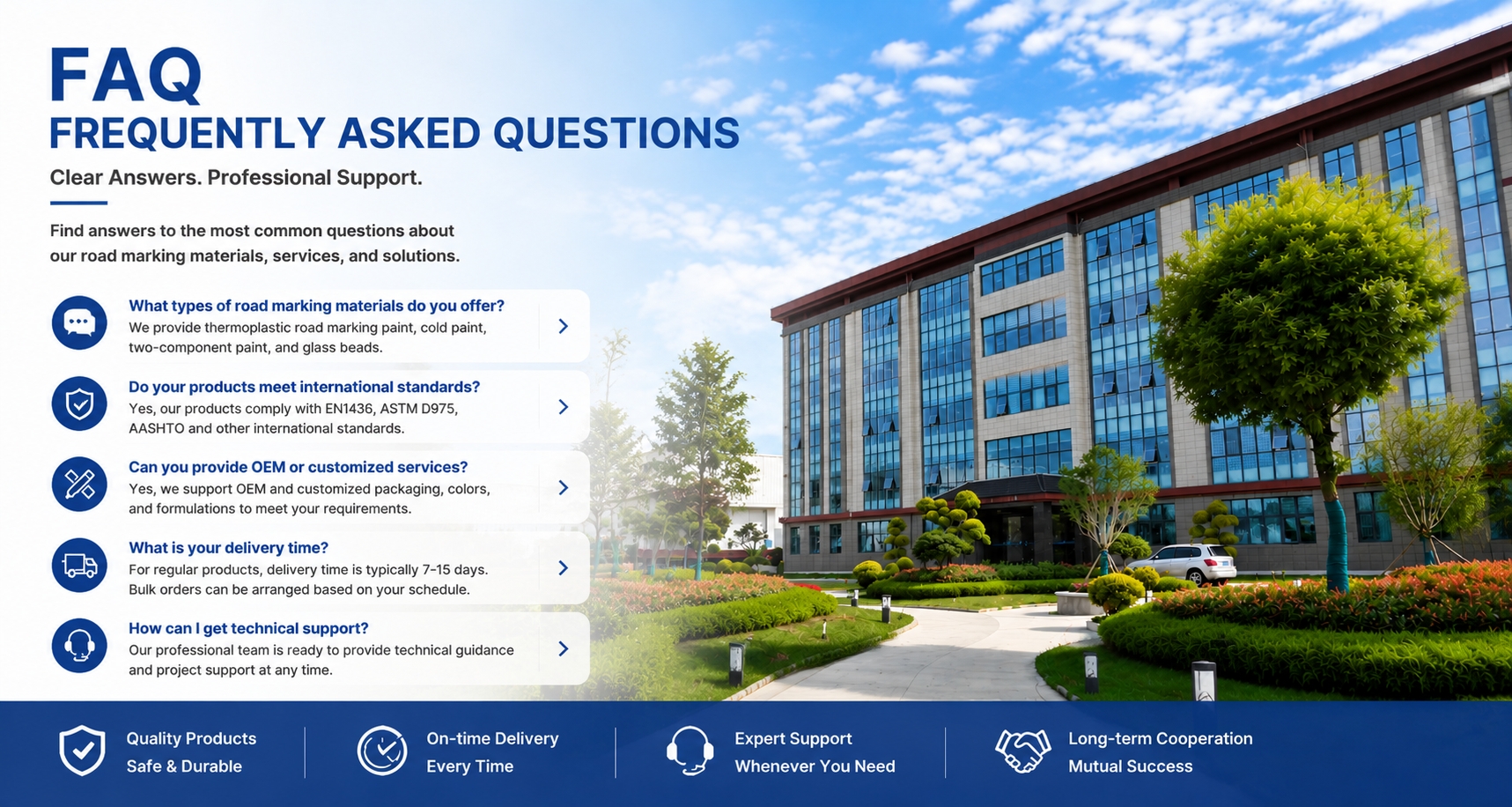
This FAQ page sorts out typical consulting questions collected from global road contractors, municipal procurement departments and international building material wholesalers. All content covers our core export products: thermoplastic road marking paint, oscillating thermoplastic marking paint and supporting road marking construction equipment, helping overseas buyers quickly understand product parameters, export standards, construction specifications, packaging and after-sales service.
1. What international standards can your thermoplastic road marking paint meet?
Our conventional thermoplastic road marking paint is produced strictly in accordance with China JT/T 280-2022 industry standard, and we can provide test reports to meet EU EN 1436 road marking performance requirements for most overseas markets. All raw materials adopt high-quality C5 petroleum resin, mixed with wear-resistant mineral fillers and pre-mixed reflective glass beads. The finished paint features strong anti-aging, anti-cracking and high retro-reflection performance, suitable for highways, municipal roads, airport runways, parking lots and factory roads in all climate zones.
2. What is the difference between ordinary thermoplastic paint and oscillating thermoplastic road marking paint?
Ordinary thermoplastic road marking paint is flat coating, mainly used for straight lane lines, edge lines and parking space markings, focusing on stable night reflective performance and long service life.Oscillating thermoplastic marking paint is a special road safety material for speed reminding and warning sections. After construction, it forms regular raised striped markings on the road surface. When vehicles roll over the markings, obvious vibration and noise will be generated to remind drivers to slow down. It is widely used at highway toll stations, sharp bends, school road sections, tunnel entrances and pedestrian crossing warning areas. Both two types of materials belong to hot-melt solid powder, not dangerous goods, with convenient sea transportation and simple customs clearance procedures.
3. What is the standard service life of your thermoplastic road marking?
Under normal light to medium traffic flow and standard construction conditions, the service life of ordinary thermoplastic road markings can reach 2 to 3 years. For heavy-load trunk roads, port freight passages and highway long downhill sections, the service life will be slightly shortened to 1.5 to 2 years. We will recommend customers to increase the coating thickness properly and use high-refractive surface-spread glass beads to extend the service cycle of road markings according to local traffic volume and climate environment.
4. Do you supply matching reflective glass beads together with thermoplastic marking paint?
Yes, we can provide two types of reflective glass beads for global customers: pre-mixed glass beads added inside thermoplastic paint and surface-spread glass beads scattered on the surface of hot markings during construction. We have two mainstream refractive index options: 1.5 standard glass beads for conventional municipal projects and 1.93 high-refractive glass beads for rainy night high-standard highway projects. All glass beads can be packaged separately in woven bags to facilitate container bulk shipment together with thermoplastic paint.
5. What package do you use for export thermoplastic road marking paint?
The standard export package is 25kg kraft woven bag with inner plastic waterproof liner. Each 20GP container can load about 22 tons of thermoplastic marking paint, and 40HQ container can load around 26 tons. We can support customized printing of your brand LOGO on the outer packaging bags. All goods are solid powder materials, non-dangerous goods, no need for dangerous goods certification, with fast customs clearance and flexible shipping arrangements.
6. What types of road marking machines do you provide for overseas customers?
We supply full sets of hot-melt road marking construction equipment, including hand-push thermoplastic road marking machines, self-propelled road marking machines, oscillating marking dedicated scribing machines, road pre-heaters, road blowers and road surface cleaning machines. All equipment is equipped with international standard motors and wear-resistant marking buckets, suitable for small parking lot projects and large highway bidding projects. We can provide complete equipment operation manuals in English and supporting spare parts supply service.
7. What construction temperature is required for thermoplastic road marking paint?
The recommended melting temperature range of thermoplastic paint is 180℃ to 220℃. After fully stirring and melting evenly, the hot paint can be paved on the cleaned and dry road surface. The optimal construction ambient temperature is between 10℃ and 35℃. Construction should be avoided on rainy, snowy, dewy and heavily dusty days to ensure the adhesion between the marking layer and the road base. For low-temperature regions, we can provide low-temperature resistant customized thermoplastic paint formula to prevent marking cracking in cold winter.
8. What is your minimum order quantity for export orders?
The MOQ of thermoplastic road marking paint is one full 20GP container. For customers who need to purchase road marking machines separately, we support small-batch trial orders for 1 to 5 sets of equipment. Conventional formula paints and standard marking machines are always in stock, and the delivery cycle is within 7 working days after receiving your deposit. For customized color, formula or brand packaging orders, the production lead time is about 10 to 15 working days.
9. Can you provide a full set of customs clearance documents for export?
Certainly. We can provide commercial invoice, packing list, bill of lading, factory inspection test report, certificate of origin and other standard customs clearance documents required for global sea transportation. For countries that require formal product certification, we can apply for corresponding test reports according to local traffic engineering access standards to ensure your smooth customs clearance and project bidding filing.
10. Do you offer free technical support for overseas construction teams?
We will provide free English operation manuals, detailed construction process documents and video tutorials for thermoplastic paint and road marking machines. For large-volume national road infrastructure bidding orders, our technical team can offer online one-to-one construction guidance, helping your local construction team master raw material melting, equipment debugging, pavement pretreatment and glass bead scattering standard operations to avoid common construction defects such as marking peeling, poor reflection and uneven coating thickness.