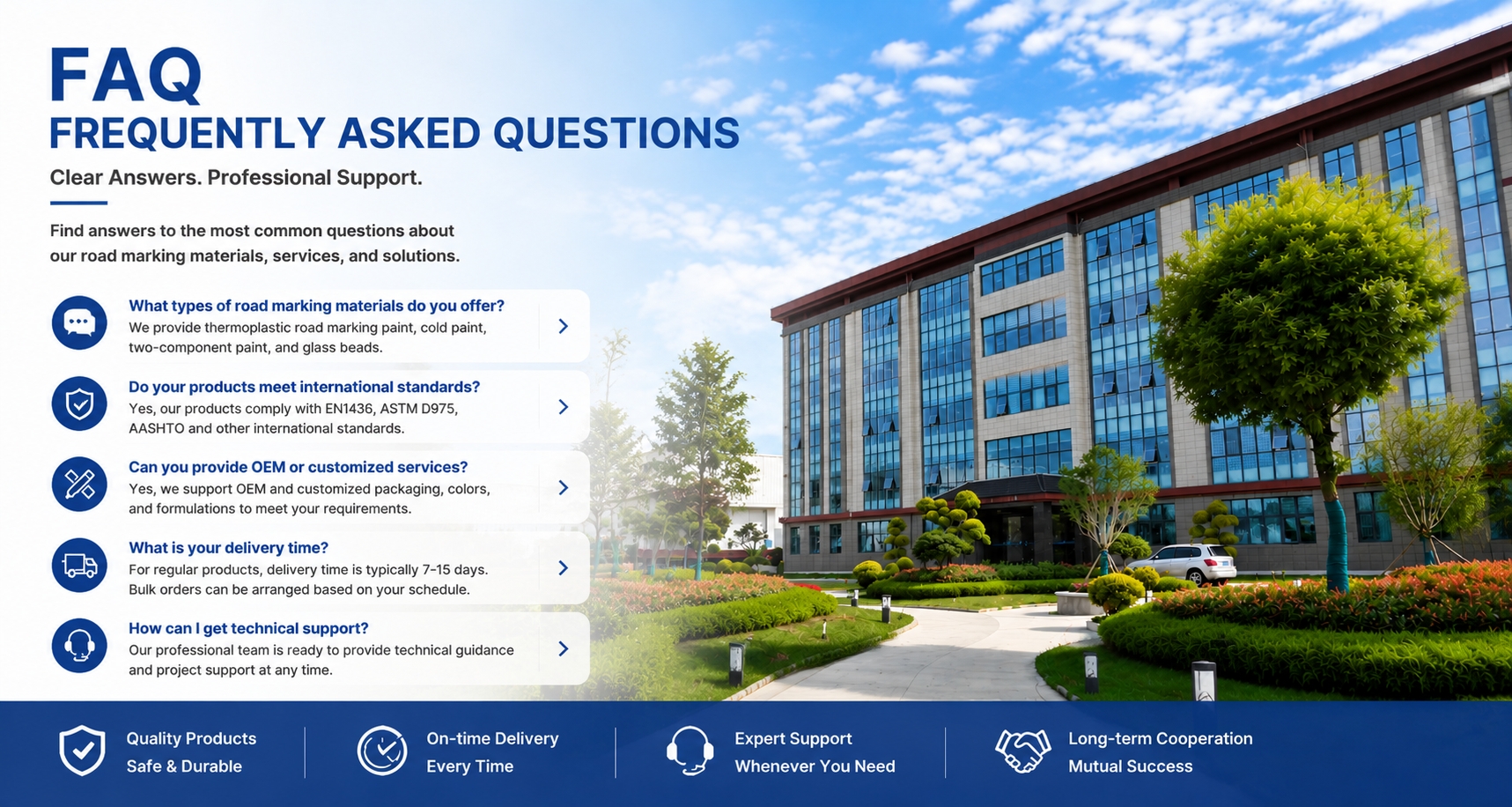
Global road construction contractors, government road maintenance departments, and international trading companies often face various doubts when purchasing and using hot melt road marking paint. Different countries have different climate conditions, road standards, certification requirements, and export trade rules. Many overseas buyers encounter problems such as improper formula selection, unclear export procedures, uncertain product quality standards, and unfamiliar construction skills.
To help global customers make faster and more accurate purchasing decisions, we have sorted out the most frequently asked questions about thermoplastic road marking paint in international trade, covering product performance, quality standards, export certification, construction guidance, order policies, shipping solutions and after-sales service. All answers are based on real export experience and international engineering standards, suitable for buyers from Southeast Asia, Africa, the Middle East, Europe and other regions.
1. What is hot melt road marking paint?
Hot melt road marking paint, also known as thermoplastic road marking coating, is a solid powder functional coating specially used for traffic road marking. Unlike liquid cold spray paint, it is solvent-free, non-toxic and environmentally friendly. Under high temperature heating between 180℃ to 220℃, the powder material melts into a flowing liquid state and is paved on asphalt or cement roads. After rapid cooling, it forms a dense, hard and highly adhesive marking layer with strong wear resistance and stable reflective performance. It is currently the most widely used road marking material for formal highway and municipal engineering projects worldwide.
2. What are the advantages of thermoplastic road paint compared with cold spray paint?
Many overseas buyers confuse hot melt paint with cold spray paint. In actual engineering applications, thermoplastic hot melt paint has obvious comprehensive advantages. First, it has a longer service life, generally 2 to 3 years, while cold spray paint usually fades and wears out within 6 to 12 months. Second, hot melt marking lines have better night and rainy day reflection effects due to pre-mixed and surface-spread glass beads. Third, the coating hardness and compression resistance are stronger, which can adapt to long-term vehicle rolling on heavy-load roads. In addition, hot melt paint has no volatile organic compounds, which meets most international environmental protection standards and is more suitable for large-scale official road projects.
3. What international standards does your export hot melt paint comply with?
Our export-grade hot melt road marking paint strictly follows international industry specifications, including ISO quality system standards and global road marking performance requirements. The core performance indicators such as softening point, wear resistance, retroreflection coefficient and glass bead content all meet international engineering acceptance standards. All export products can provide complete test reports, factory qualification certificates and customs clearance documents. For customers in Europe, Southeast Asia and other regions with special standard requirements, we can also adjust the formula and provide corresponding compliance certification support to meet local road construction acceptance rules.
4. Is your hot melt paint suitable for tropical high-temperature and rainy climates?
Yes. We have special climate-adaptive formulas for global different regions. For tropical countries with high temperature, high humidity and heavy rainfall all year round, we provide high-temperature resistant and anti-aging hot melt formulas with a softening point of 100℃-110℃. This formula can effectively avoid line softening, flowing and deformation caused by high pavement temperature, and resist ultraviolet radiation and rain erosion, preventing short-term fading and powder dropping. It is very suitable for long-term road maintenance projects in Southeast Asia, South Asia and equatorial coastal areas.
5. Can the thermoplastic paint adapt to low-temperature and cold-region construction?
Standard hot melt paint can adapt to normal temperature construction above 10℃. For low-temperature regions with large temperature difference, we provide improved flexible cold-resistant formulas. The optimized material has better low-temperature toughness, which can effectively avoid cracking and peeling caused by road thermal expansion and cold contraction. It can meet the construction and long-term use requirements of temperate zones and high-altitude mountainous areas, solving the common problem that ordinary hot melt paint is easy to crack in winter.
6. How long is the service life of exported hot melt road marking lines?
The service life depends on road traffic volume and construction thickness. Under standard construction thickness of 1.8mm-2.0mm, the service life of municipal urban roads is 2-3 years. For heavy-load highways, port passages and industrial roads with frequent vehicle braking and rolling, the service life is about 1.5-2 years. Compared with other road marking materials, hot melt paint has the lowest comprehensive maintenance cost and is the most cost-effective solution for long-term road engineering projects.
7. What kind of construction equipment is needed for hot melt marking paint?
Hot melt thermoplastic paint requires professional road marking construction equipment, including hot melt kettle heating equipment, hand-push or self-propelled marking machines, and glass bead spreaders. The paint needs to be evenly heated and melted to 190℃-210℃ before paving. Different from cold spray paint that can be constructed at room temperature, hot melt construction has certain technical requirements, but the final molding effect and durability are far better. We can provide customers with construction guidance videos and professional technical parameter suggestions to ensure perfect construction results.
8. Do you support customized formulas for special road projects?
Yes, we support personalized formula customization for global customers. According to local climate characteristics, road load level, project acceptance standards and customer budget, we can adjust the ratio of resin, wear-resistant filler, titanium dioxide and glass bead content. We can produce high wear-resistant formula, high-reflection formula, high-temperature resistant formula, low-temperature anti-crack formula and colored special formulas to meet the differentiated needs of highways, tunnels, parking lots, scenic roads and municipal special marking projects.
9. Do you provide free samples for quality testing?
We support customers to apply for free product samples for quality inspection and engineering testing. Customers only need to bear the international freight cost. The sample contains standard white and yellow hot melt paint, which can help customers test melting effect, hardness, color and reflection performance locally. It is the most effective way for foreign buyers to verify factory product quality before placing bulk orders.
10. What is your MOQ for export orders?
Our factory has flexible order policies for global customers. The conventional minimum order quantity is 1 ton, which is friendly for small-scale engineering trials and new customer cooperation. For large infrastructure projects and long-term cooperative agents, we support bulk wholesale with more favorable factory prices and priority delivery rights. Whether it is a small trial order or a large-scale government project procurement, we can provide stable supply and complete export services.
11. What shipping and trade terms do you support?
We support mainstream international trade terms such as FOB, CFR and CIF. We have long-term cooperative shipping agents, which can provide stable and cheap sea freight services for Southeast Asia, Africa, the Middle East, Europe and other routes. The goods are packed in standard export waterproof woven bags, with complete packing list, invoice and customs clearance documents to ensure smooth customs clearance in the destination country.
12. What payment methods are acceptable for foreign trade orders?
We support secure international payment methods, including T/T bank transfer and irrevocable L/C at sight. For long-term cooperative customers, we can negotiate flexible payment terms. All transaction processes comply with international trade norms, ensuring the fund safety and order legitimacy of both buyers and sellers.
13. How to store hot melt thermoplastic paint correctly?
Hot melt road marking powder should be stored in a dry, ventilated and moisture-proof warehouse, avoiding long-term direct sunlight and rain soaking. The stacking height should not be too high to prevent extrusion agglomeration. Under standard storage conditions, the product shelf life is 12 months. Before construction, place the powder in a dry environment to ensure stable melting performance and avoid affecting the construction effect.
14. What are the common construction mistakes to avoid?
The most common construction errors include unclean pavement, residual oil and dust, no primer coating on cement roads, improper heating temperature, and incorrect glass bead spreading time. Too high heating temperature will cause paint aging and discoloration, while too low temperature will lead to poor adhesion and easy peeling. Glass beads spread too early or too late will directly affect the night reflection effect. Standardized construction operation can maximize the service life and safety performance of hot melt marking lines.
15. What after-sales support can you provide for overseas projects?
We provide full-cycle after-sales service for global export orders. Including product quality guarantee, remote construction technical guidance, project problem analysis and solution support. If customers encounter quality problems or construction confusion during project use, our professional technical team can provide timely response and professional solutions to ensure the smooth progress of overseas road marking projects.
Conclusion
Hot melt road marking paint is the most reliable and cost-effective road marking material for global infrastructure projects. Most buyer doubts are concentrated on product adaptation, international standards, export procedures and construction details. By choosing professional export manufacturers with mature formulas and complete certification, overseas customers can avoid quality risks, solve construction problems, and obtain stable and long-term road marking effects. For any other questions about thermoplastic road paint purchasing and engineering application, you can contact our team for one-on-one professional technical support and export quotation.